

September 2026
September at a glance
September was about giving your customers a seat at the table. You can now divide a customer into teams and hold each one to its own credit limit, and anyone can build a dashboard on their Paid data by describing it, then embed it for a customer to watch live. The app had a visual refresh, search is a keystroke away from anywhere, and the API gained read endpoints for credit movements and bank transfer details.
Items marked Early access are switched on for selected organizations rather than everyone. If you want one of them enabled, ask your Paid contact.
Split a customer into teams, and cap what each one spends
A customer is no longer a single bucket of credits. You can now describe the structure inside a customer — departments, squads, environments, whatever matches how they buy — and set a spend cap on any part of it, for a period you choose. Spend rolls up the tree, so a cap on a parent watches the whole branch. Paid evaluates caps on a schedule and tells you when one is reached; it keeps recording spend, so your product decides what to do about it.
Each unit is addressed by your own key, not a Paid id, so the structure you already have in your
system is the structure you use here. Keys are kept unique within your organization, a unit’s
whole history is recorded, and a cap’s schedule survives later edits rather than being silently
reset. When a cap is reached, Paid sends a billing-credit-cap-reached webhook so your product
can react before anyone’s work is refused.
Available through the API, the SDKs and the CLI. Customer units and credit caps
Built by: Min, Nabil, Nassim
Build a dashboard by describing it, and embed it for your customer
Custom views are available to everyone. Describe the dashboard you want to an AI assistant, point it at your Paid data, and save the result — it appears under Custom views in the Analyze section. Narrow a view to one customer and you can publish it and embed it in your own product, so that customer sees a live view of their own usage and value where they already work. Views can be shared by link, given preview-only timeframes, and unpublished again when you are done.
Create a custom view with Claude · Embed a custom view
Built by: Binh, Camille, Georgi, Ivan
Billing and credits: improvements and fixes
- When tax calculation is switched on, you can set a tax code per product line instead of one code for the whole organization.
- Backprocessing an order now always replays its credits, so a corrected order and its credit ledger cannot drift apart.
- Plan order lines accept price and discount overrides, and the order page shows the full line detail, including the credits an order grants.
- A customer’s bank transfer details can be read back rather than only created, and incoming transfers are reconciled against the customer automatically, with a daily sweep for any that were missed. Bank transfers
- Early access. Graduated credit bracket rates, so a credit price can step by volume, with unit conversion handled for you.
Built by: Binh, Camille, Gareth, Ivan, Nabil, Nassim, Raj, Xifong
Turn usage into signals you can bill
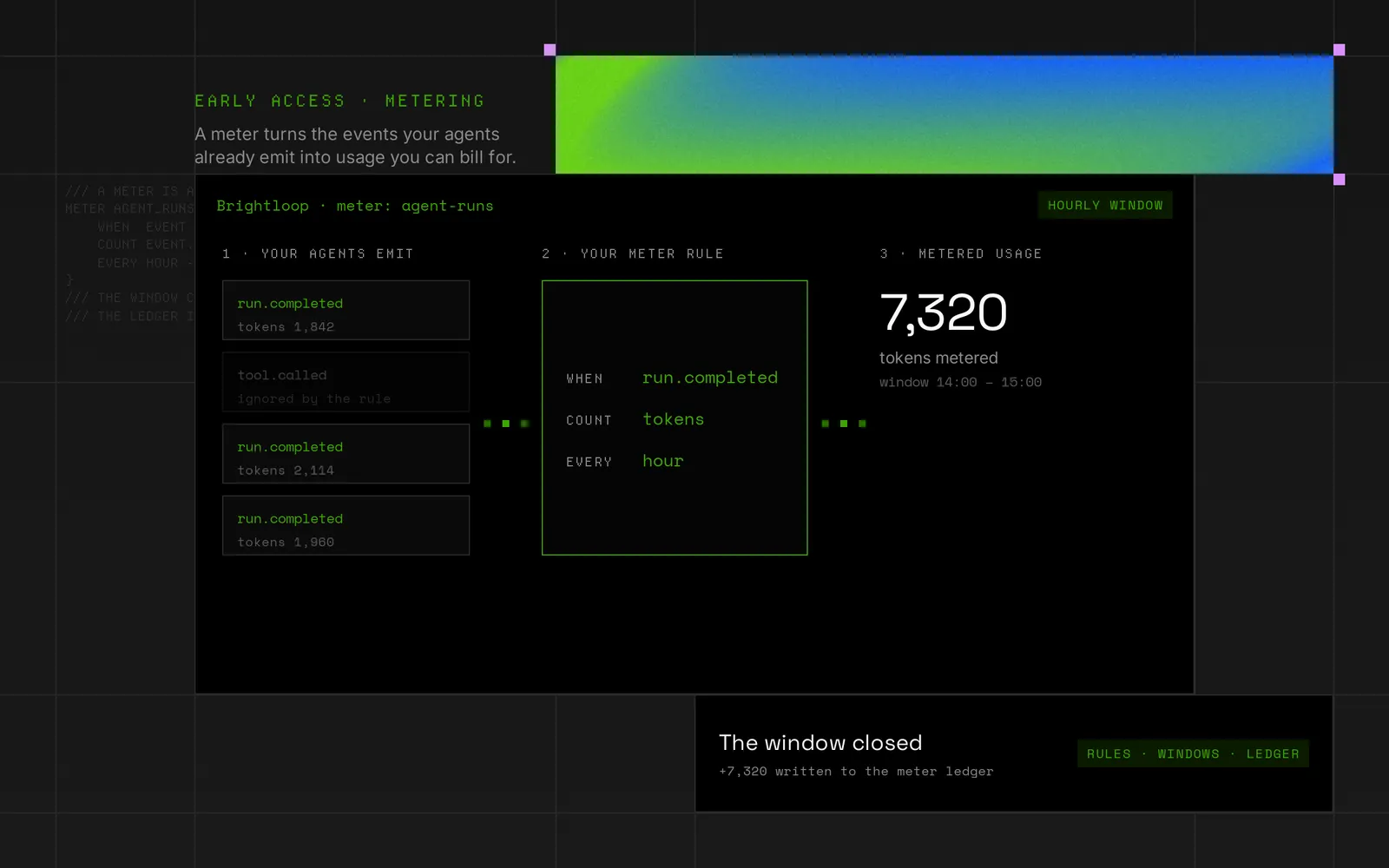
- Early access. Metering is switched on for selected organizations. A rule says which usage counts, a window groups it over a period of your choosing, and the signals that come out bill like any other. A ledger shows every window and what it produced, rules can be filtered by status with inactive ones out of the way, and a detail panel narrates what happened inside a window. Meters
Built by: Gareth, Lewis, Nabil, Nassim, Xifong
App experience: improvements and fixes
- Search is available to everyone: ⌘K (Ctrl+K on Windows) opens a palette that jumps straight to a page, customer, invoice or order, with your recent destinations listed first.
- The app had a visual refresh — spacing, typography, icons, overlays, switches and tables all moved onto one design system in a single pass. Nothing moved and nothing behaves differently.
- Every chart in the app — signals, costs, delivered value, billings — now shares one theme, with consistent formats, tooltips and colours.
- The customers table, credit ledger, billings grid and overview page were rebuilt on the new design, with numeric columns aligned, a legend you can click to filter, and empty states that explain themselves.
Built by: Binh, Camille, Georgi, Ivan, Léo, Marta, Ulysse, Will
For developers: new read APIs, exports and the provisioning endpoint
What changes. The v2 API gained read surfaces that previously existed only inside the app:
GET /api/v2/credits/transactionsandGET /api/v2/credits/transactions/summary— the credit ledger, and a bucketed burn summary grouped by event name and credit currency, with exact decimal amounts. CreditsPOST/GET /api/v2/customers/{id}/funding-instructions, and the same pair under/api/v2/customers/external/{externalId}/funding-instructionswhen you address customers by your own id — create and read a customer’s virtual bank account for bank-transfer payment. Bank transfersPOST /api/v2/provisionis now part of the public spec, with an API reference page, SDK methods, a CLI command and an MCP tool. It enforces idempotency keys and order locks, so a replayed call cannot provision twice. Provisioning from a CRM- Customer units and credit caps have a full CRUD surface under
/api/v2/customers/{id}/customer-units. Customer units and credit caps - Signal usage summaries can be exported as a spreadsheet-ready CSV through an asynchronous export job, and grouped summaries are now served synchronously from the rollup, by display id or your own external customer id. Chart signal volume
Who is affected. Anyone building on the v2 API, the SDKs, the CLI or MCP. Everything in this section is additive.
What to do, and by when. Nothing is required. Regenerate or upgrade your SDK when you want the new methods.
Built by: Gareth, Georgi, Lewis, Min, Nassim, Xifong